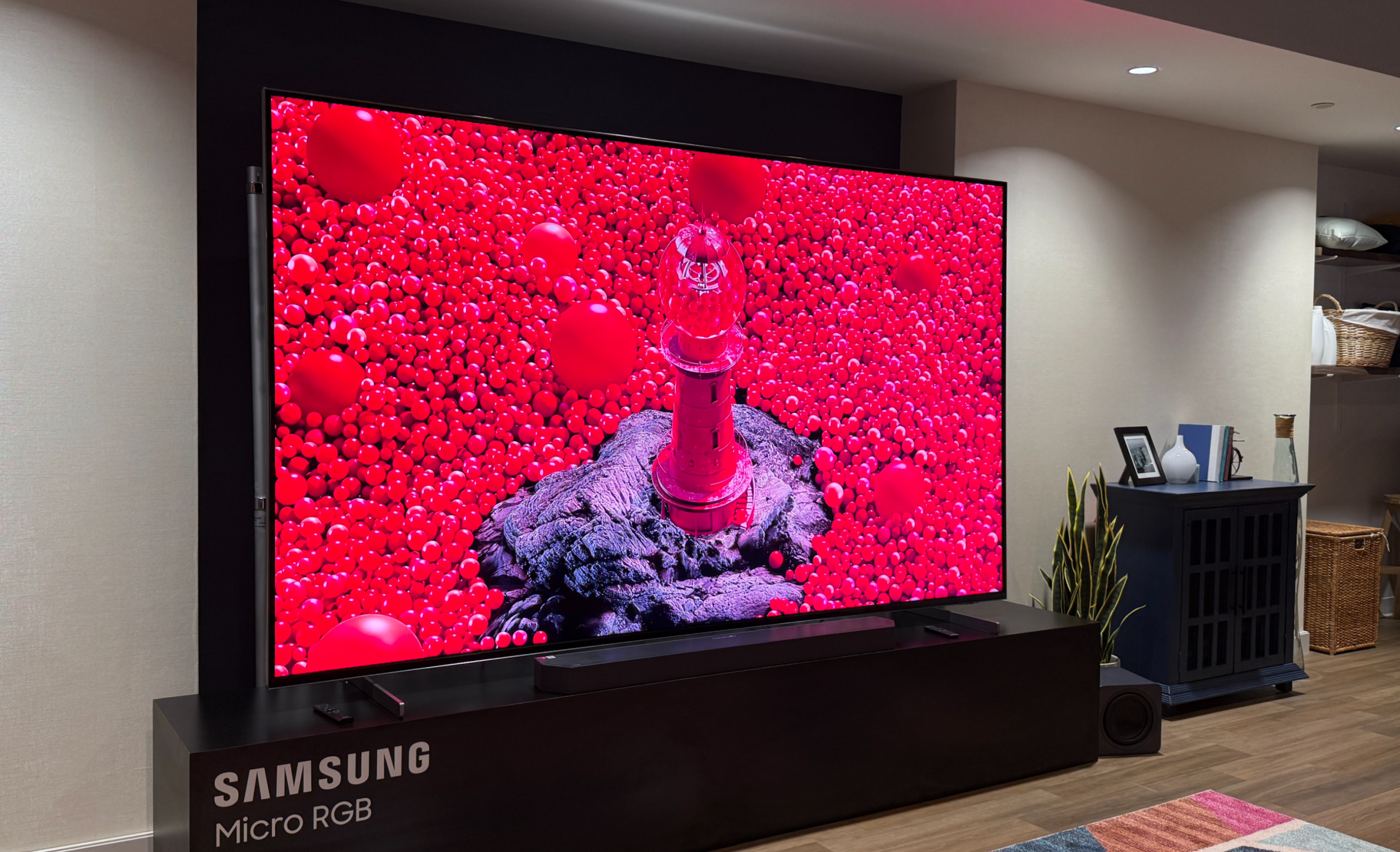
The war for the ultimate large-screen TV has officially escalated—and Samsung has fired a serious shot with its colossal 115-inch Neo QLED QN90F RGB LED 4K Smart TV.
Now appearing in select Harvey Norman stores, this isn’t just another premium television—it’s a statement product. At this scale, ownership isn’t just about picture quality; it’s about logistics, space, and whether your home can physically accommodate something this large. For many buyers, getting it through the front door—or into a lift—may be as challenging as justifying the $41,999 price tag.
After spending time with this giant, one thing is clear: Samsung has delivered something genuinely impressive. But whether it’s worth it is a more complex question.
First Impressions: A TV That Redefines “Big”
There are large TVs, and then there’s this.
At 115 inches, the Samsung RGB LED TV doesn’t just dominate a room—it transforms it. This is the kind of display that shifts your viewing experience from “watching TV” to something closer to a private cinema setup.
However, size comes with compromises. Installation is not trivial. This is a TV that will realistically only suit larger homes, dedicated media rooms, or ground-floor apartments with easy access. For many, this alone will be a deciding factor before picture quality even enters the conversation.
Price vs Alternatives: TV vs Projector Debate
At $41K, this TV sits in a category where buyers are often considering projector or laser TV systems instead.
And this is where Samsung starts to make a strong case.
A comparable premium projector setup—such as a Sony projection system paired with a screen and audio solution—can easily climb past $50,000. Melbourne-based Audio Active, for example, offers a Sony projector rig with screen and soundbar for around $55,000.
When viewed through that lens, Samsung’s offering begins to look more competitive. You’re getting a single, integrated display with no need for external screens, alignment, or complex installation. There’s also no compromise in ambient light performance—a traditional weakness of projection systems.
Understanding RGB LED: The Technology Behind the Hype
The real story here is Samsung’s RGB LED technology, which represents a significant shift in how modern TVs produce light.
Traditional Mini-LED TVs rely on a white or blue backlight that passes through colour filters. OLED, on the other hand, uses self-emissive pixels, where each pixel generates its own light.
RGB LED sits somewhere between the two—but with a key difference.
Instead of a filtered backlight, RGB LED uses dedicated red, green, and blue LEDs for each pixel, resulting in:
Significantly higher brightness (reportedly exceeding 6,000 nits)
A much wider colour gamut
Greater colour accuracy without relying heavily on filters
Samsung claims full BT.2020 colour space coverage—roughly 75% of the colours visible to the human eye. In real-world viewing, this translates to vibrant, highly saturated colours that still retain a level of realism.
The panel itself is driving over 24 million individual light sources, with one red, one green, and one blue LED per pixel across a 4K resolution (3840 x 2160). That’s an enormous amount of precision—and it shows.
RGB LED vs OLED vs Mini-LED
The natural comparison here is OLED—and rightly so.
OLED still holds the advantage in absolute black levels due to its pixel-level light control. However, RGB LED closes the gap in several important areas:
Brightness: RGB LED is dramatically brighter
Colour Volume: Stronger at higher brightness levels
Longevity: No burn-in concerns
Scalability: Available in sizes OLED simply cannot match
In fact, one of the biggest advantages Samsung has right now is size. You simply cannot buy an OLED TV at 115 inches. That market has traditionally been the domain of custom installations and projection systems.
RGB LED, while still in its early stages, is clearly being positioned as the future of large-format displays.
Picture Quality: Big, Bright, and (Mostly) Beautiful
So how does it actually look?
In short: very good—but not flawless.
Colour performance is impressive. There’s strong saturation, excellent brightness, and a sense of vibrancy that immediately grabs attention. Sports, in particular, look stunning, with bright uniforms and fast motion popping off the screen.
However, out of the box, the colour profile can feel slightly overcooked—almost too vibrant. This is where calibration becomes essential.
With some tweaking—adjusting gamma, local dimming, and brightness—the image becomes far more balanced and natural. Samsung’s advanced settings, including Filmmaker Mode, Movie Mode, and Dynamic Mode, give users plenty of flexibility.
Once dialled in, the experience is genuinely immersive.
The 8K Question: Is 4K Enough at This Size?
This is where things get interesting.
Samsung’s own 9 Series 8K Neo QLED TVs still have the edge when it comes to fine detail. When comparing side-by-side, the 8K panels deliver more texture—particularly in close-ups. Facial detail, skin texture, and subtle image depth are more pronounced.
On a screen this large, resolution does matter.
While the 4K RGB LED panel looks excellent, there are moments where you can’t help but wonder whether 8K would better suit a display of this scale.
Performance: Where This TV Truly Excels
If there’s one area where this TV clearly shines, it’s sport and gaming.
The combination of extreme brightness, colour punch, and massive screen size creates an incredibly engaging experience. Fast-moving content is handled well, and the scale makes everything feel more immersive.
For gaming, the experience is equally compelling. The responsiveness, clarity, and sheer size deliver a level of immersion that few displays can match.
Movies and drama content are still enjoyable—but this isn’t where the TV feels most at home. The brightness and colour intensity, while impressive, can occasionally feel less suited to more subtle cinematic content.
Practical Considerations: The Hidden Challenges
Beyond price, there are a few realities to consider:
Installation complexity – This is not a DIY setup
Space requirements – Requires a large room to do it justice
Viewing distance – You need space to fully appreciate the scale
Transport limitations – Not every home can physically accommodate delivery
This is a TV designed for a very specific type of buyer.
The Verdict: A Glimpse of the Future
Samsung’s 115-inch RGB LED TV is undeniably impressive. It delivers cutting-edge brightness, strong colour performance, and a scale that transforms how content is experienced.
But it also raises important questions.
At $41K, you’re firmly in luxury territory. And while this TV competes strongly with high-end projector systems, it also faces competition from Samsung’s own 8K lineup when it comes to pure image detail.
What you’re really buying here is size + brightness + next-gen technology.
RGB LED is clearly a technology with enormous potential. This may be an early iteration, but it’s already delivering a compelling experience—particularly for sport, gaming, and general viewing.
For those with the space, the budget, and the desire to own one of the biggest and brightest TVs on the market, this is an easy recommendation.
For everyone else?
It’s a fascinating glimpse into where TV technology is heading next.
Rating:9/10